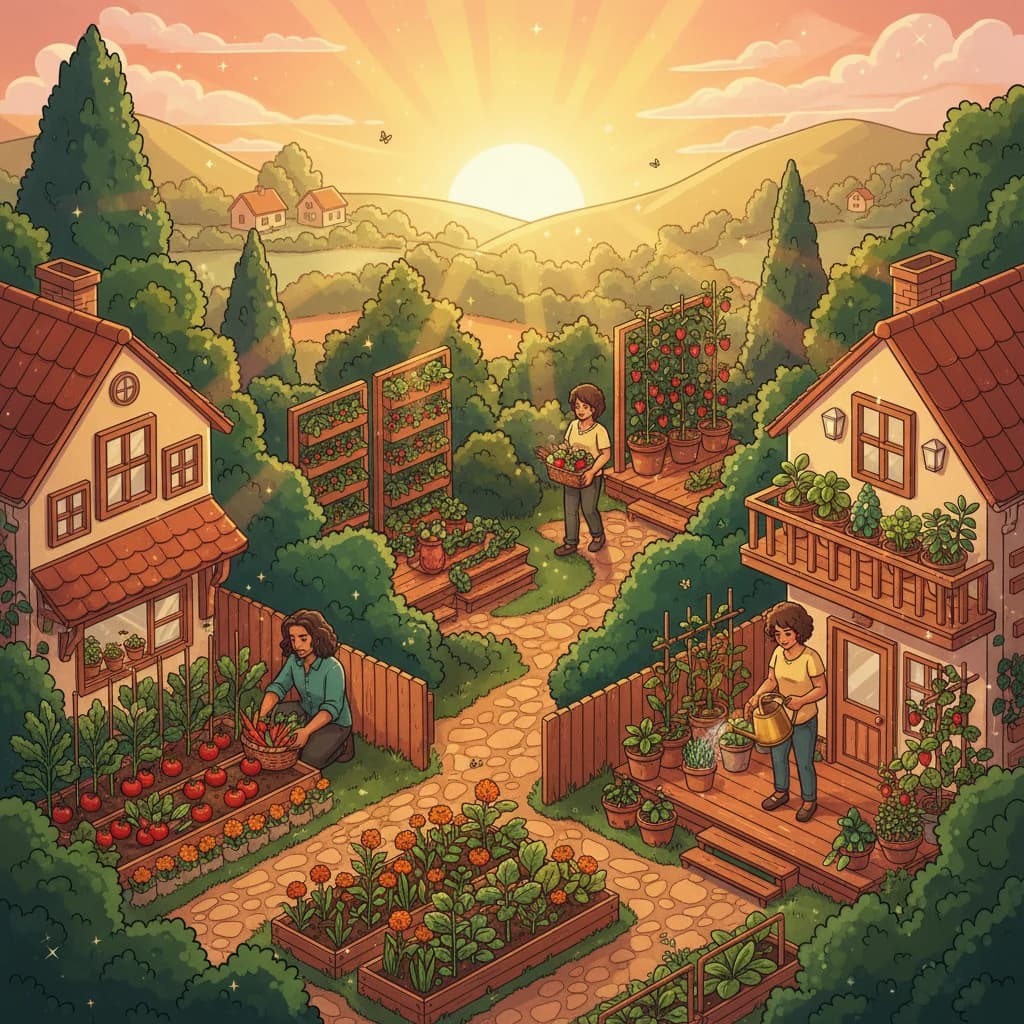
Designing Your Garden Layout
8 min read

What You'll Learn
Bring everything together into a complete garden design — positioning beds, paths, water, compost, and vertical structures.
The Master Plan

You now know how to read your space, build beds, go vertical, water efficiently, and compost. In this final Level 3 lesson, we're going to bring it all together into a complete garden design.
A good garden layout isn't just about where plants go — it's about how everything flows together. Water access, pathways, compost proximity, sun orientation, and growth heights all play a role. Get the layout right and your garden practically runs itself.
The Design Principles

1. Orient to the sun. In the Northern Hemisphere, your tallest plants and structures go on the north side. Each row steps down in height moving south. This ensures nothing shades anything else.
2. Keep water close. Place your beds as close to a water source as practical. Running a hose 100 feet is annoying — you'll water less, and your plants will suffer.
3. Put compost near the kitchen. If your compost bin is far from your kitchen, you won't use it. Place it along the path you naturally walk, and you'll compost without thinking about it.
4. Create flowing paths. You should be able to reach every part of your garden without stepping on growing soil. Design paths that flow in a circuit, not dead ends.
5. Group by water needs. Thirsty plants (tomatoes, cucumbers) together, drought-tolerant plants (rosemary, lavender) together. This lets you water efficiently without over- or under-watering anything.
Tip
Draw your layout on paper before you build anything. Move things around on paper until the flow feels natural. It's much easier to erase a line than to relocate a raised bed.
Sample Layout — Small Yard

Here's a sample layout for a typical small backyard:
North side:
- Compost bin in the back corner
- Tall trellis against the fence for pole beans and cucumbers
Center:
- Two 4×8 foot raised beds oriented east-west for maximum sun
- Wood chip paths between beds (36 inches wide for wheelbarrow access)
- Drip irrigation running from the spigot to both beds
South side:
- Herb containers near the kitchen door (closest to where you cook)
- A hanging basket of strawberries from the porch overhang
- A small flower border along the front for pollinators
Key features:
- Water spigot with a timer and drip system
- Mulched paths connecting everything
- Compost bin within 30 feet of both the kitchen and the beds
- Tallest plants (trellised) on the north, shortest (herbs) on the south
Sample Layout — Balcony/Patio

Even a small balcony can produce a surprising amount of food:
Back wall:
- Vertical grow tower for lettuce and herbs (floor space of one pot)
- Wall-mounted planters for trailing herbs
Railing:
- Railing planters with herbs and salad greens
Floor:
- Two 5-gallon fabric grow bags with tomatoes
- One 10-gallon grow bag with peppers
- Self-watering container with mixed herbs
Overhead:
- Hanging basket with strawberries or cherry tomatoes
Key features:
- Self-watering containers to reduce daily maintenance
- Vertical and overhead growing to maximize limited floor space
- All containers positioned to catch the most sun
- A small compost bin or worm bin under a bench
Did You Know?
A well-designed balcony garden can produce 50–100 pounds of food per year. That's enough for a salad every day of the growing season, plus herbs for cooking, plus tomatoes for snacking — all from 30–40 square feet of balcony space.
Planning for the Seasons

A great layout also considers time — not just space:
Spring (cool season):
- Plant peas, lettuce, spinach, radishes, kale
- Start warm-season seedlings indoors
- Turn in winter cover crops
- Top-dress beds with compost
Summer (warm season):
- Transplant tomatoes, peppers, squash, beans
- Succession plant lettuce every 2–3 weeks for continuous harvest
- Keep up with watering and mulching
- Watch for pests, manage naturally
Fall (cool season return):
- Plant garlic, kale, spinach for fall harvest
- Plant cover crops on empty beds
- Continue harvesting warm-season crops until frost
- Clean up spent plants and add to compost
Winter:
- Rest. Let cover crops and mulch do their work.
- Plan next season's layout changes
- Start seeds indoors in late winter
Tip
Sketch out a seasonal planting plan alongside your spatial layout. Know what goes where AND when. This prevents the common mistake of planting everything at once and then having nothing to plant mid-season.
Common Layout Mistakes to Avoid

Too much, too fast. Start with 1–2 beds your first year. Expand later. An overly ambitious garden that overwhelms you is worse than a small one that you enjoy.
No paths. Without paths, you'll step on your soil, compacting it. Plan paths before beds, not after.
Ignoring water access. A beautiful garden that's 200 feet from a water source is a garden that dies in August. Keep water close.
Not thinking about height. A trellis on the south side of your garden will shade everything behind it. Always plan heights from north (tall) to south (short).
Forgetting about the future. Leave room to expand. That empty corner? Leave it for next season's raised bed or a future fruit tree.
What This Means For You

You've completed Level 3: Garden Architect. You now have the skills to design and build a complete growing space:
- Read your space — sun mapping, microclimates, wind, and drainage
- Build your beds — raised beds, in-ground no-dig, or containers
- Go vertical — trellises, towers, hanging gardens
- Water efficiently — soaker hoses, drip irrigation, self-watering systems
- Compost like a pro — bin types, troubleshooting, small-space methods
- Design the layout — orient to sun, keep water close, plan heights, flow paths
The skill you've earned — Garden Design — means you can take any space and turn it into a productive growing area.
Level 4: The Green Thumb is where it all comes together. You'll learn the hands-on skills — starting seeds, transplanting, companion planting, succession planting, crop rotation, and natural pest management. The garden is built. Now let's grow.
Check Your Understanding
Answer these questions to complete the lesson and see how other learners responded.
Question 1 of 3
In the Northern Hemisphere, where should the tallest garden structures be placed?
Enjoying the Academy?
Sign up for free to track your progress, earn skills, and get personalized planting dates.
Sign Up for Free